
What Does Ashton Kutcher Have To Do With Revitalization?
What do Ashton Kutcher, Elijah Wood, Ron Livingston and Terry Farrell have in common?
All four actors hail from Cedar Rapids, Iowa and its immediate vicinity. That’s quite impressive for a city of roughly 138,000 and an MSA of 280,000.
In working on a retail strategy for that city’s struggling Downtown core, I have proposed that stakeholders approach these celebrities with a pitch to reinvest in their hometown, perhaps even put their name(s) on businesses that could help to attract patrons and visitors. I have argued that they are likely to resonate a whole lot more with Gen X’ers and Millennials who watched Office Space, That 70’s Show, the Lord of the Rings and Star Trek: Deep Space Nine than the city’s longtime favorite son, artist Grant Wood, who painted American Gothic nearly a century ago — especially at the current moment, with the 1990’s and early 2000’s having returned to prominence in pop culture.
After all, appealing to the sentimental attachments of such “boomerang(s)” seems like a more promising strategy than trying to convince an outside investor from scratch.
Of course, not every community can point to a famous actor (or four) who was born and raised there. But boomerangs need not have become widely famous. I was recently checking out Lubbock, a West Texas city of 273,000 (and MSA of 369,000) that is best known for two things: Buddy Holly, the 1950’s era rock-and-roll pioneer, and Texas Tech, where Patrick Mahomes quarterbacked the Red Raiders in the mid-2010’s.
While the city boasts some vibrant bits in the Overton and Tech Terrace precincts to the east and south of the university’s massive campus as well as the Buddy Holly-themed Depot District just south of the core, the Downtown itself has a little ways to go. Sleepy would be an understatement. However, a handful of pioneering restaurateurs and hoteliers have been managing to give it some life.
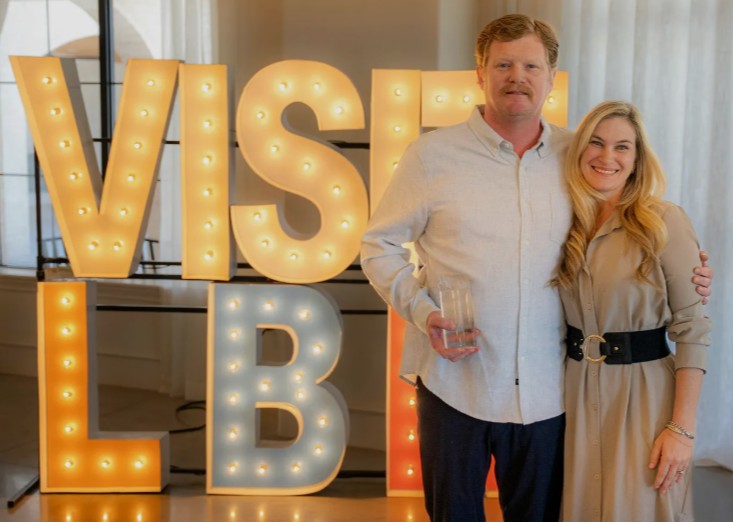
One of these is Cameron West (lead image above, with wife Rachel). Born and raised in Lubbock, grandson of a famed local Mayor, he graduated from Texas Tech and then left for the coast, to attend the Culinary Institute of America (CIA) in California’s Napa Valley. He proceeded to work with acclaimed chefs at fine-dining establishments in Orlando and Dallas-Fort Worth.
And yet he felt the pull of his old stomping grounds. He had watched as other chefs returned home and helped to revive their Downtowns, and he sensed latent demand in Lubbock for a dining renaissance. In 2014, he and Rachel, also a Texas Tech grad, opened The West Table Kitchen & Bar, a modern chef-driven concept featuring a seasonal menu and craft cocktails — a novelty there, at the time. He chose to put it in the city’s then-barren Downtown, on the ground floor of the ’20’s-era building that once housed the city’s premier hotel — helping to further differentiate it in the marketplace.
“We learned lots of different things from different places we’ve been,” West said, “but we really loved the community here in Lubbock, and we really wanted to bring a restaurant to Lubbock that could satisfy the want for a little bit more upscale food in a cool location that people could enjoy.”
Of course, part of it had to do with lifestyle as well. “I thought it would be in the [Dallas-Fort Worth] Metroplex,” said West, “but once you start having kids, the cost of living — I convinced my wife and we came home. I’ve always loved Lubbock.”
Outsiders — and probably most locals — would have viewed Downtown Lubbock as a very dicey location for a white-tablecloth restaurant at the time. West, however, was the sort of pioneer that revitalization professionals dream of; he saw a district poised for something more. “I felt [The West Table] would be successful,” he said. “I knew there was discretionary income floating around. People took trips, and with the education and food experiences on those travels, they started realizing the hole we truly had.”
The West Table soon became a culinary destination. Four years later, in the same building, West debuted The Brewery LBK, a craft brewpub intended to inject some new energy into a local beer scene that seemed well behind the times. Then, in the pandemic’s first year, a few blocks away, he opened a West Texas-style joint for fried chicken and beer, Dirk’s, partly as a homage to his grandfather, the former Mayor. (With Neighborhood F&B, he has since expanded beyond the local beltway to his first suburban location).
In the process, Cameron and his wife have inspired other boomerangs with fine-dining pedigrees to plant their flags in Downtown, including Finn Walter, who premiered The Nicollet in 2020 – which was included on Bon Appetit’s Best New American Restaurants list in 2022 – and Jon Walter, who opened Chez Sami in 2023 – which garnered him a nomination for the James Beard Award for Best Chef: Texas that same year). Explaining his motivations, the latter said that “there’s a lot of people downtown that really want to drive and change the way downtown is looking, and I want to be a part of that.”
Historically, Lubbock was more likely to be associated in the popular imagination with chicken fried steak than refined French cooking, but with concepts like these, it is clearly evolving. Indeed, as evidence of its rising profile, the city was said to be “maturing as a culinary destination” in a January 2024 Austin Chronicle column. And while such recognition certainly does not solve everything (and while I will never underplay the life-changing potential of sublime comfort food), it can help to broaden the appeal to a wider audience and spur even more reverse migration.
The point here is that the ones most likely to spark such a process might be hiding in plain sight. In lieu of a well-known celebrity, many cities and towns can point to natives who left to do great things elsewhere and might be enticed to return for their hometown’s next chapter, perhaps even to play a catalytic role. They might harbor an optimism born of intimate familiarity and genuine affection, rather than a cold calculus based on investment criteria. And often, in our Downtowns, that’s what it will take.