
The Latest on the Opportunity for Small-Format Grocery
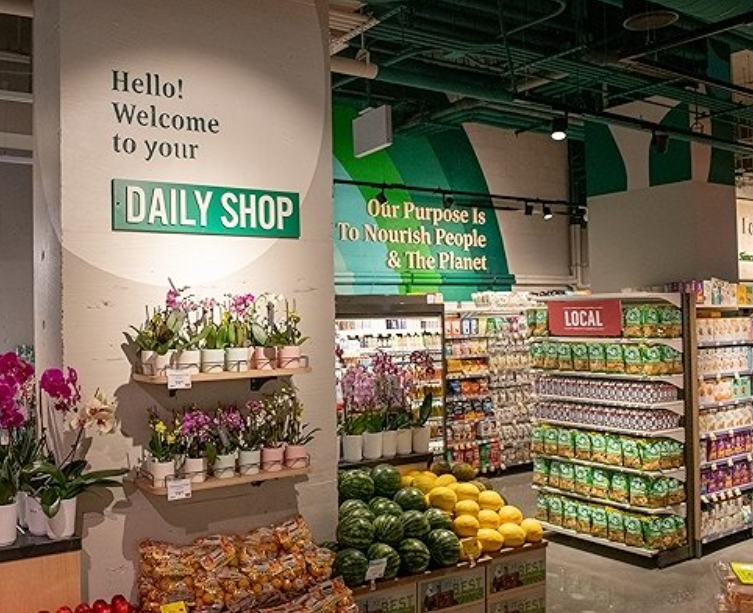
So it seems that Whole Foods Market’s “Daily Shop” format is a success, with expansion continuing beyond the 2024 launch in Manhattan. New stores are opening in New York City’s outer boroughs (Brooklyn and Queens), in six locations across London as well as several other top-tier U.S. metros including Washington, D.C., Philadelphia, Boston and Chicago (see link below), with “more to come,” according to Christina Minardi, VP of Real Estate and Store Development.
Color me a tad skeptical about the U.K. launch — Whole Foods as a brand is not as prominent there, while that nation’s largest supermarket chains moved on this opportunity long ago and saturated the urban fabric with sub-brands like Tesco “Express”, Sainsbury “Local” and “Little” Waitrose. We’ll see how it goes here in the States. Large chains like Kroger’s, Albertson’s, Costco’s and H-E-B’s have made little effort to explore such potential. There have been some exceptions on the local level, like Philadelphia’s GIANT Heirloom Market and San Francisco’s Luke’s Local, but nothing even approaching Whole Foods’ (Amazon’s) scale — a factor that Zohran Mamdani appears not to have considered. Perhaps the biggest threat will be Target’s “flexible-format” stores, which have a decent-sized national footprint and feature a modest selection of grocery items. That battle will likely be won or lost on merchandising and pricing.
Yet while the rollout of Daily Shop is no doubt exciting news for Downtowns and city neighborhoods, one needs to keep in mind that this category is still mostly about rooftops. Office workers might stop in for lunch, but most households shop for groceries close to home. Population thresholds, then, must be met, either now or in the very near future. Interestingly, though, the compactness of the format’s trade areas — with a radius of 0.5 to 0.75 miles — means that one could exist not all that far from a full-service Whole Foods Market. The new location planned for Philadelphia’s South Street will sit little more than a mile away from an existing store along that same corridor.
The case in Philadelphia also points to a potential roadblock for Daily Shop. There, the Daily Shop will be replacing a local grocer, South Square Market, that has built enough of a following in its roughly 20 years of operation to spawn a Change.org petition in protest. Depending in part on the psychographic composition of the neighborhoods surrounding its proposed locations, this can complicate Whole Foods’ rollout and/or limit sales volumes, particularly as expansion will likely focus on urban submarkets that are at least somewhat established and might already contain viable alternatives in close proximity. In this sense, the competitive context could be determinative.
So what about those submarkets that will be unlikely to reach the necessary thresholds anytime soon?
Well, some cities can draw on the upmarket convenience-store model pioneered by Royal Blue Grocery in Austin and the now-revived Foxtrot in Chicago, though their selection can be somewhat limited, with more of an emphasis on quick-service food/beverage and specialty food items. In other communities, the public/non-profit sector might work closely with a property owner to identify, lobby and incentivize a local grocery chain-let, though again, the presence (or near-term promise) of enough housing will still be essential, for long-term sustainability if not initial attraction. Other possibilities include a “shop-in-shop,” whereby, say, a full-service restaurant devotes a portion of its space to food retail (which can also serve its own interests, as a hedge against spoilage of perishables), or a robust farmers market.
Stay tuned for future developments in this ever-evolving space!