
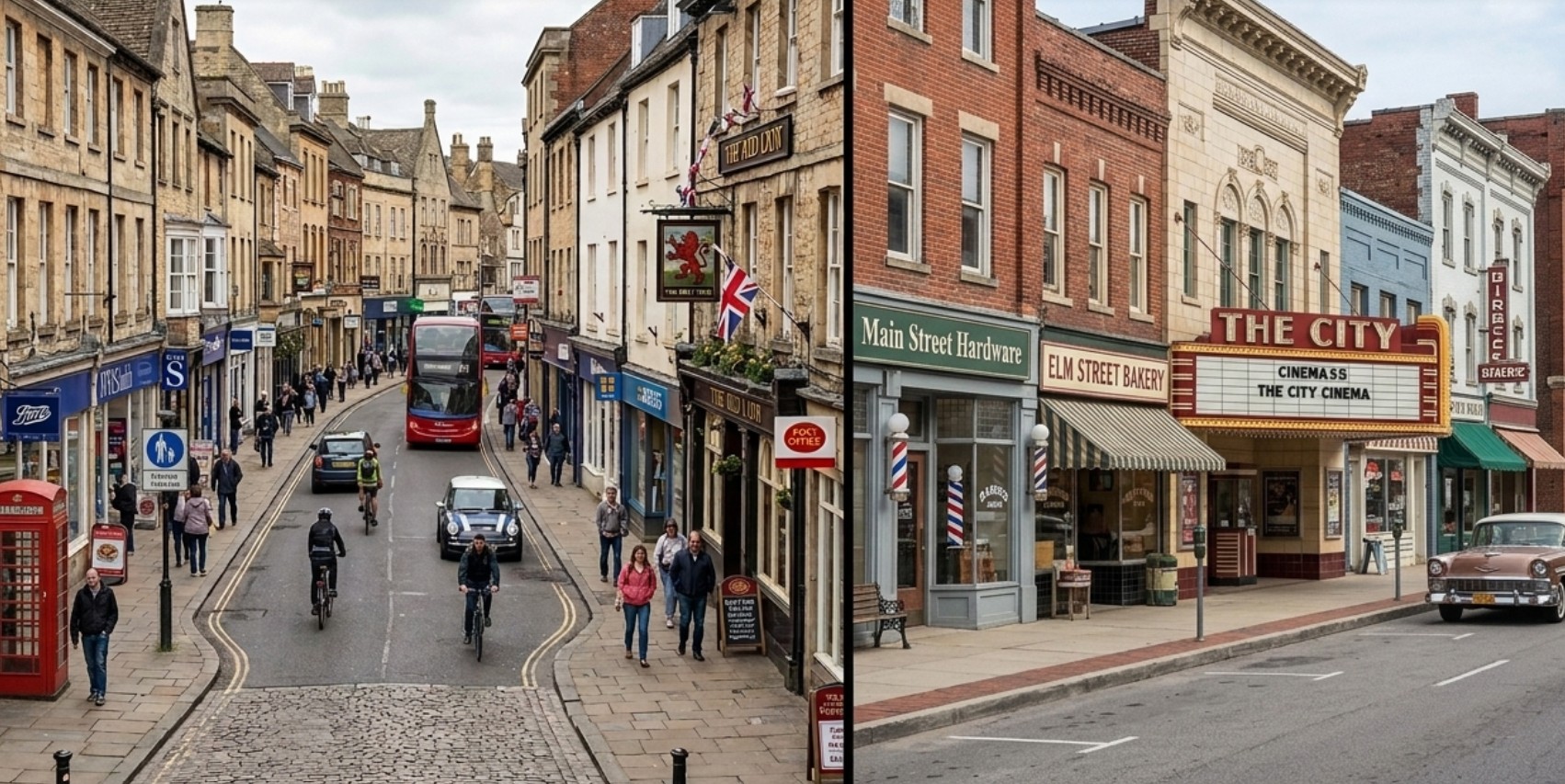
Do Downtowns really matter to Americans?
The differences between the U.S. and the U.K. have long fascinated me, ever since I did my graduate work in England during the mid-1990’s and as I have returned there intermittently to consult or speak.
Consider that Nigel Farage has pointed specifically to the struggles of the “high street” as a reason why voters should favor his Reform UK party’s candidate over Labour’s in upcoming local elections, particularly in the struggling, post-industrial, “left behind” regions of the country where conditions have declined the most (and where Reform UK has tended to perform well).
Meanwhile, Keir Starmer’s Labour government, in part as a response to Farage, has been touting its “Pride in Place” initiative, which will provide regeneration funding for hundreds of the U.K.’s most deprived areas and their ailing high streets while also further empowering such communities vis-a-vis private property owners.
Think about this for a moment: when was the last time, in the U.S., that Downtowns were such central preoccupations to the leaders of our national parties?
Context to the contrast
“Main Street” in the American context has long acted as a metonym of sorts, a proxy for the economy as it is experienced by individuals and small businesses (typically in contrast to “Wall Street”). But such usage has only a loose relationship with main street as a physical place. Farage and Starmer, on the other hand, are talking specifically about the districts themselves.
This is not entirely a surprise, reflecting the high street’s far greater prominence in U.K. consumer culture. Indeed, it was not until the 2000’s that high streets started to lose their relevance as the shopping destinations in their respective markets – when I was living there in the 1990’s, their retail mixes still resembled those of healthy U.S. malls, so much so that they were widely derided as “clone towns” or “identikit towns.”
In the U.S., the Downtown started to lose their status way back in the 1960’s, as retail reoriented to the freestanding mall and the commercial strip. And while we might, if we are old enough, indulge our nostalgia about them, we have not since then cherished our Downtowns quite like Britons have their high streets – at least not enough to consider the kinds of policies that helped the latter retain their primacy for another 40 years or so across the U.K.
Perhaps this is why the U.K.’s political leaders seem to intuitively grasp the impact of high street decline on the way in which its voters feel today about their communities and their country. We in the U.S. routinely underestimate the disproportionate role that ground floor tenancy (or vacancy) plays, if even subconsciously, in our perceptions of districts and their surrounding neighborhoods, or, more broadly, in the raw anger and distrust that courses through our politics. It has certainly not figured all that prominently in our national or even our state elections.
Donald Trump has hinted in passing at the devastating impacts of past trade deals on the main streets of the Rust Belt, as well as blamed blue-state governance for pandemic-era disorder in the urban core. But I would argue that these allusions function as part of a larger argument he is making in the culture wars than as problems in their own right, with real policy prescriptions to follow.
The same might be said about Nigel Farage. Let me be clear: I am not a fan, nor do I believe that he has a serious plan for the regeneration of these places or an ability to implement it. The U.K., with roughly one-fifth of the population and 1/40th of the land area as well as a historically more centralized planning system, is not an ideal analog for the U.S. in any event. But my larger point is that clearly Farage — and Starmer — see the issue as one that could conceivably resonate with voters. In other words, they believe that there is a constituency for the high street which can be mobilized.
That is not the case with the U.S. electorate. For all of the ink that was spilled on the urban “doom loop” in the early part of the decade, did any of it really have a direct bearing on the 2024 Presidential race, the 2020, 2022 or 2024 Senatorial races, or, for that matter, gubernatorial elections? The perceived chaos at the heart of (select) U.S. cities likely did contribute to broader (negative) sentiment about the state of the nation, though most of that centered on homelessness and antisocial behavior — the subject of elevated storefront vacancy barely figured at all.
So, what does this have to do with our work?
I routinely ask my clients in the U.S. to explain if and how their Downtowns are “relevant” to the rest of their respective cities and metros. Often, and especially in smaller markets, they will respond that yes, of course, Downtown is “the heart” of the community. I am congenitally incapable of letting such platitudes pass without challenge, and so I will push, asking for concrete evidence that their Downtown truly retains that sort of currency.
Understand here that I am not talking about policy. The International Downtown Association (IDA) plays a critical role on that front, with its “Value of U.S. Downtowns and Center Cities” research and reports as well as its other advocacy efforts. But politics, as they say, is downstream of culture, and so we must also concern ourselves with the proverbial man (woman) on the street. How much do our Downtowns resonate with that audience?
My starting point is that in most cases, we cannot rely on any sense of incumbency. In other words, the Downtown in the American context is not the default option. Rather, we have to make it relevant to people; the burden is on us, as place managers, to give them a reason to care once again, because, left to their own devices, in a convenience-driven society with lots of alternatives, they most likely will not.
To be sure, the revitalization community – place managers, municipalities, private-sector actors and other partners — have landed on some effective approaches for doing that in the last few decades. Most of these, however, are not oriented towards the mass market; they do not revive Downtowns as the destinations that they once were. Rather, they tend to focus on specific populations and niches, otherwise staying in their proverbial lane(s).
This partly explains my frustration with the trend in our industry today to reframe Downtown as just another (residential) neighborhood. At a moment when we need to be strategizing about how to expand our tent, we seem to be proposing an even smaller one. After all, no one is driving in from the suburbs or exurbs for neighborhood-serving businesses like a CorePower Yoga, an AFC Urgent Care or a Chipotle Mexican Grill.
I will concede that a focus on the most likely near-term customer is often what my Downtown strategies recommend as well — but it is a focus on the near-term customer from beyond, not from within. And while such “destination” potential might seem modest at first, I deliberately ground the approach in practicality as a means to aspiration — based on my hypothesis that practicality today begets aspiration tomorrow, that doubling down on what can work now — on who can be enticed now — actually offers the most likely and efficient route to a wider embrace in the future.
While their politics are quite messy at the moment as well, I am jealous of the British. The high street is dealing with some serious challenges, but it is also a cultural touchstone. That by no means ensures the success of their regeneration schemes, but it does at least guarantee the kind of attention and visibility that seems essential to such efforts. In the U.S., on the other hand, we will need to be a lot more intentional – in our economic development initiatives, our master plans, our marketing campaigns and other realms of place management – if we are going to create places that will once again matter to a broader populace.