
Yes, Downtowns must reinvent themselves — as visitor destinations
Yes, Downtowns do need to reinvent themselves in the post-pandemic era — but not only, or even primarily, as residential neighborhoods. They must also create new reasons to visit, for people who do not already live or work there. After all, it is such “destination-driven” traffic — whether from other city neighborhoods, from farther-flung suburbs or from beyond the region — which has always fueled consumer spending in so many of our Downtowns, and which remains today an essential ingredient to sustaining their sizeable retail footprints.
This might require stakeholders to take some “big swings” — high-risk/high-reward efforts to develop large-scale attractions that can raise a Downtown’s profile, extend its reach and drive higher footfall.
I realize that such forays have an uneven history, in many cases promising far more than they ultimately delivered. If you build it, they do not necessarily come. I have also long argued that at least with retail-focused projects, trying to realize long-term (or, as I call them, “end-state”) aspirations in one fell swoop often backfire.
I would like to think, though, that we have learned a thing or two from the mistakes of the past. With this in mind, I have been proposing an approach which does not put all of the proverbial eggs in one basket but rather, like a diversified investment portfolio, couples the long plays on potential game-changers with more practical initiatives designated to yield near-term results. We can work and chew gum at the same time.
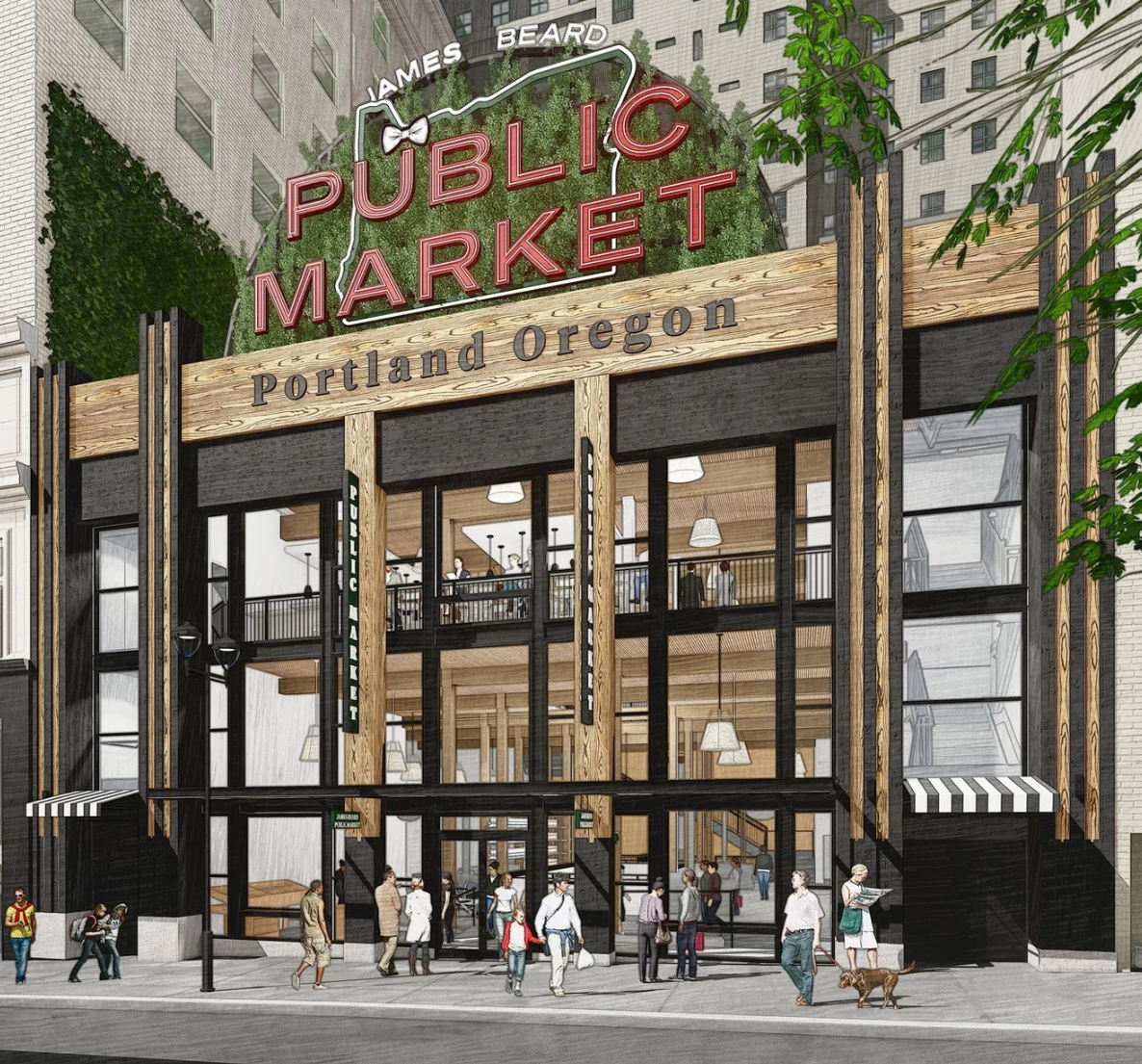
I have been working in the Downtown of Portland (OR), which is hoping to cut the ribbon on a big swing in 2027 that seems likely to connect in today’s food-obsessed culture: the James Beard Public Market, a 38,000 square foot showcase for local farmers, artisans and chefs that stakeholders envision as the Rose City’s version of Seattle’s Pike Place Market. To get on the national radar screen, project sponsors have shrewdly leveraged the name recognition and cachet of the famed food personality, who was born and raised there. They are expecting that it will draw at least one million annual visitors.
Separately, an enterprising property owner in Downtown Portland has proposed a museum dedicated to sneakers, which I have loudly supported in my findings, not just because it is a subject of interest (if not obsession) among a sizable swath of the general population, but also, it has been closely associated with the city and state, as the corporate headquarters of Nike as well as a regional base for Adidas, On Running and HOKA.
Can your community draw on a particular legacy or identity in the development of an attraction that would resonate with the broader public? Or, if not, can you mine your history for something that can be elevated to serve that purpose? Consider the inspiring example of Cleveland: did many people think of the city as the “Birthplace of Rock ‘N’ Roll” before it parlayed a since-disgraced radio DJ’s coinage of the term some forty years earlier into the Rock & Roll Hall of Fame and Museum, which is today the city’s most popular tourist attraction, drawing more than 500,000 visitors per year?
Of course such projects need not just be limited to buildings but also, transformative public spaces. Like Manhattan’s High Line or San Antonio’s Riverwalk. Indeed, I continue to be impressed with San Antonio’s willingness to be bold and take some chances on visionary projects that seem reflective of its unique culture.
Obviously these are not minor undertakings, and will almost certainly require long lead times as well as complex funding schemes. The James Beard Public Market was first conceived in the late 1990’s and has endured numerous twists and turns, including a recent announcement of yet another delay.
But that’s why the process needs to start now. In the Downtowns of Portland and Houston, I have recommended that the public/non-profit sector convene a task force, consisting of major stakeholders (including, importantly, the private sector ones), that would meet on a fairly regular basis to brainstorm ideas, consider roadblocks, assign responsibilities and coordinate efforts.
We tend to valorize Downtowns that evolve in a purportedly “organic” fashion, yet in truth that’s not really how it works. Maybe, to an extent, once momentum starts to take hold, but such momentum must first be catalyzed, and that usually requires a degree of intentionality — our leaders actually trying things and yes, sometimes watching them flop.
Riffing on Daniel Burnham’s famous quote, we might need to make little plans and big ones — both.